
Written by a boilermaker with 25 years of FIFO experience across oil and gas, mining and construction.
Every FIFO job ad lists a roster, and if you’re new it can look like a code. Here’s what the common ones mean and what they’re like to live with.
How to read a roster
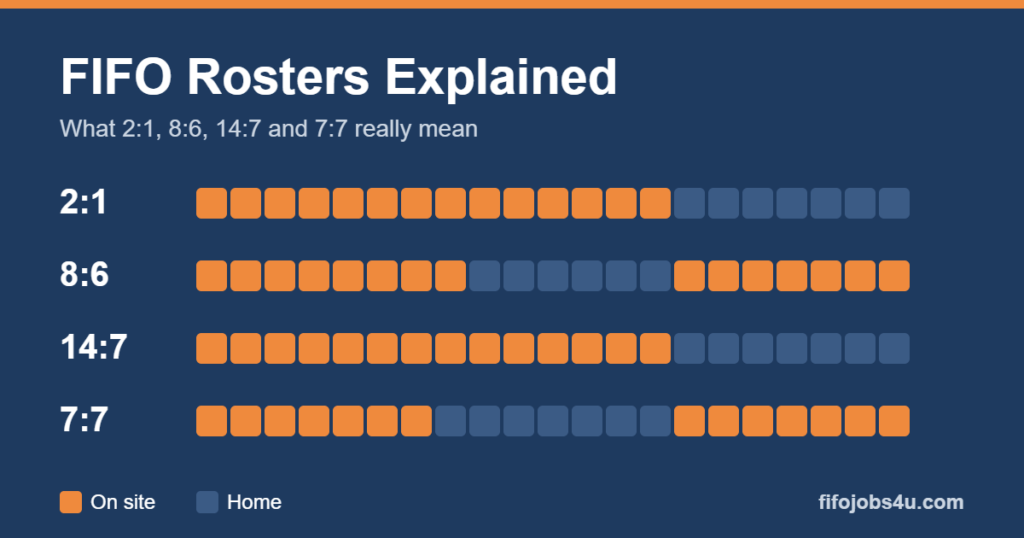
The first number is time on site, the second is time at home. Some rosters are in weeks (2:1) and some are in days (8:6, 14:7).
The common rosters
- 2:1 (two weeks on, one week off) – common for construction and shutdown work. Good money, but you spend most of your time away.
- 8:6 (eight days on, six off) – popular on Pilbara iron ore sites. A good balance between work and home.
- 14:7 (fourteen days on, seven off) – the same ratio as 2:1, written in days.
- 7:7 (seven on, seven off) – often called “even time”. Great for family life, but these roles are usually harder to get.
- 4:3 or 5:2 – shorter swings, usually drive-in drive-out (DIDO) or closer to town.
Day and night shift
Many rosters swap between day and night shift. For example, on an 8:6 you might do four days then four nights. Ads often write this as “7D/7N” or “4D/4N”. Night shift is tough at first, so plan your sleep and food.
Travel days
Check whether flights happen on your own time or are paid. Some rosters count the flight day as a work day, others don’t. It’s worth asking before you sign.
Which roster is right for you?
If you’ve got a young family, even time or 8:6 is usually easier at home. If you want to save hard, 2:1 and shutdown work can pay well. Talk it through with your family before you start, because the roster shapes your whole life.
Ready to look? Browse FIFO jobs in the Pilbara, the Bowen Basin or entry level FIFO jobs.